
Rehabilitation movement tracking is moving from the clinic into daily life. Rehabilitation succeeds or fails on movement — how a patient moves now, how that changes over weeks, and whether they are moving safely. For most of clinical history, that assessment relied on the therapist’s eye and a goniometer. Wearable inertial sensors add an objective, quantitative layer: precise, repeatable measurement of how patients move during real functional tasks. This guide explains how wearable IMUs support rehabilitation and what to look for in a system.
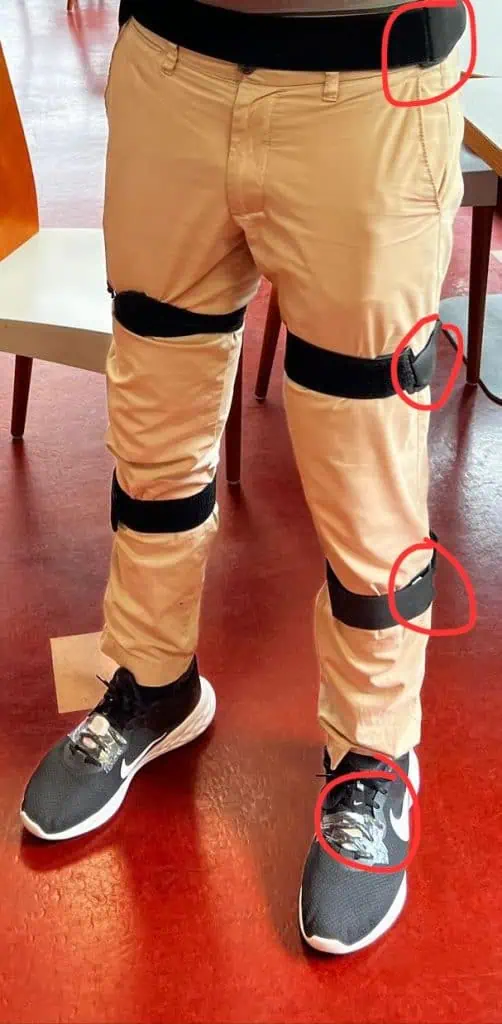
Table of Contents
Why objective rehabilitation movement tracking changes outcomes
Visual assessment is valuable but subjective and hard to reproduce between clinicians or across sessions. Wearable IMUs measure joint angles, movement quality, symmetry, and timing directly, turning “looks better” into numbers you can track. That matters for three reasons: it documents progress objectively, it catches compensations and asymmetries the eye may miss, and it supports shared decision-making with patients who can see their own improvement.
Where wearables fit in the rehab pathway
- Baseline assessment. Quantify range of motion, symmetry, and movement quality at intake to set targets.
- Progress monitoring. Repeat measurements over the course of care to show whether the intervention is working.
- Biofeedback. Real-time feedback during exercises helps patients correct movement patterns as they perform them.
- Return-to-activity decisions. Objective symmetry and loading data support safer decisions about when to progress or return to sport.
- Out-of-clinic monitoring. Because IMUs are portable, movement can be measured at home or in real environments, not only in the clinic.
What the technology measures
Placed on the relevant segments, IMUs reconstruct joint angles and segment orientations through sensor fusion. From those, a system can derive range of motion, gait parameters such as cadence and stride length, inter-limb symmetry, movement smoothness, and the timing of functional tasks like sit-to-stand. Validation work shows wearable systems achieving reliability comparable to optical motion capture for lower-limb walking kinematics, which underpins their clinical credibility.
The emerging role of AI
Machine learning is expanding what rehabilitation sensors can do. Recent research uses AI to extract clinically meaningful patterns from wearable data, supporting continuous and personalised mobility assessment, and even to detect and forecast pathological gait patterns. For clinicians, this points toward earlier identification of problems and more individualised programmes — built on the foundation of reliable sensor data.
What to look for in a rehab-ready system
- Validated accuracy for the joints and tasks you assess.
- Ease and speed of setup so it fits into a busy clinical session.
- Hygiene and durability — an IP-rated, cleanable housing matters when sensors move between patients.
- Real-time capability if you want to deliver biofeedback during exercises.
- Open data and integration if you want to connect to your own records or analysis tools.
Further reading: World Health Organization.
Useful rehabilitation movement tracking is continuous, unobtrusive, and happens where the patient actually lives.
Frequently asked questions
Are wearable sensors accurate enough for clinical use?
For many movement measures, validated inertial systems achieve reliability comparable to optical motion capture. As with any clinical tool, accuracy should be confirmed for your specific assessments, but the evidence base supports their use in rehabilitation.
Can patients use these sensors at home?
Yes. Portability is a key advantage — movement can be captured outside the clinic, enabling home monitoring and more representative data about daily function. The practicality depends on the system’s ease of use and remote workflow.
How do wearables support biofeedback?
Systems with low-latency, real-time output can show patients how they are moving as they move, helping them correct patterns immediately. This turns assessment into an active part of the therapy itself.
Where QSense fits
Because recording can continue for hours with nothing in range, assessment can happen in the patient’s home rather than the clinic — the approach behind our work with Erasmus MC. See the three recording modes.
QSense provides clinicians and researchers with synchronized, validated-grade movement data: 9DOF sensors with low-latency wireless capture, an IP67 housing that stands up to repeated clinical use, and open data through a Python and C++ SDK for integration and analysis. Whether you are tracking recovery objectively or building a biofeedback workflow, see how QSense supports movement tracking or contact the team to discuss your clinical needs.
 English
 Spanish
 German
 French
 Dutch