

IMU Sensor Specifications — QSense 9DOF Motion Sensor
Complete IMU sensor specifications for the QSense 9DOF inertial measurement unit: sensor ranges, sample rates, timing and synchronization behaviour, internal recording capacity, battery, mechanical data and certification.
Sensor System
Inertial Sensors
- Accelerometer
Range: ±2 / ±4 / ±8 / ±16 g
Sensitivity: 0.061 – 0.488 mg/LSB - Gyroscope
Range: ±125 / ±250 / ±500 / ±1000 / ±2000 °/s
Sensitivity: 4.375 – 70 mdeg/s - Magnetometer
Range: ±50 Gauss
Sensitivity: 1.5 mGauss/LSB
Degrees of Freedom
- 9DOF (Accelerometer + Gyroscope + Magnetometer)
- 6DOF (Accelerometer + Gyroscope)
Data Output Modes
- Raw sensor data (acceleration, gyroscope, magnetometer)
- Quaternion output (6DOF and 9DOF, Madgwick-based)
- Mixed mode (Raw + Quaternion)
- Free acceleration
- BVH motion format
Available for both real-time streaming and onboard logging.
Timing & Synchronization
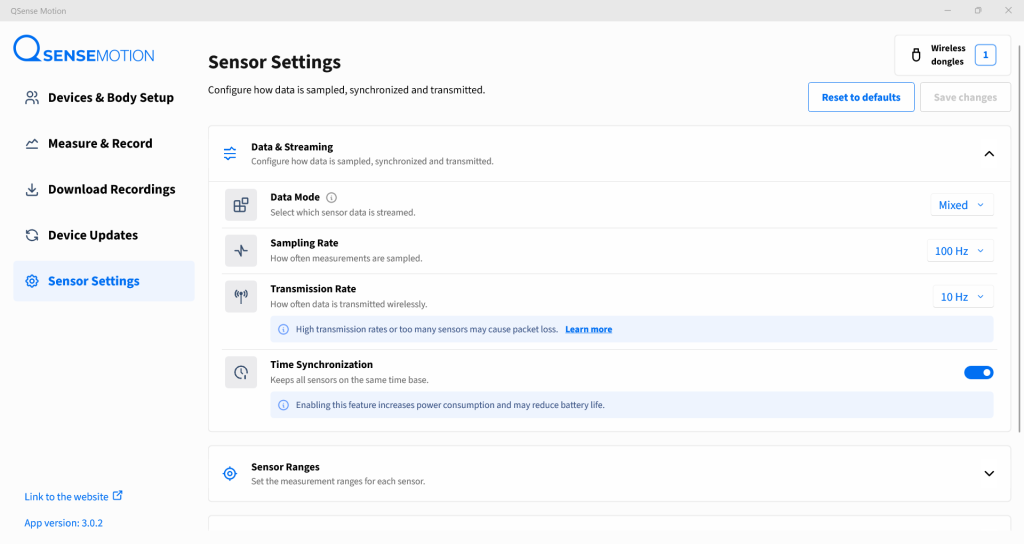
Time synchronization is a setting you enable or disable via the settings menu. With it enabled, all sensors share one time base; with it disabled, each sensor timestamps on its own clock and power consumption is lower. Latency is 7.5 ms at the sensor. Through the QSense Wireless BLE dongle the practical minimum is 15 ms; 7.5 ms is achievable with a direct BLE implementation, for example on Android or a custom host.
Time Synchronization Enabled (High-Precision)
For applications requiring deterministic timing and frame-accurate multi-sensor alignment.
Latency
- Minimum: 15 ms via the QSense Wireless BLE dongle
- Typical: 7.5 ms × number of sensors
Time Synchronization Accuracy
- Typical: < 60 µs
- Maximum: < 150 µs
Behavior
- All sensors are continuously synchronized wirelessly during measurement.
- Every sample is tagged with an absolute date/time stamp.
- Enables reliable multi-sensor fusion and alignment with external systems.
Clock Synchronization Method
- Before measurement, device clocks can be synchronized to an external host (e.g. PC, tablet).
- During measurement, sensors remain locked through continuous wireless synchronization.
- In custom implementations, time can also be set programmatically via the device interface.
Time Synchronization Disabled (Minimal Delay)
For closed-loop applications where responsiveness matters more than long-term timing precision.
Latency
- Minimum: 7.5 ms at the sensor, 15 ms via the QSense Wireless BLE dongle
- Typical: 7.5 ms × number of sensors
Time Behavior
- Each sensor timestamps data locally using its internal clock.
- No active runtime synchronization.
- Drift may accumulate over time.
Time Drift
- Worst-case drift: ≤ 2 ms per minute
Additional Offsets
- BLE communication can introduce constant offsets up to the connection interval (max 7.5 ms per device).
Clock Synchronization Method
- Before measurement, device clocks can be synchronized to an external host.
- In custom implementations, time can also be set programmatically.
Multi-Sensor Performance
The maximum achievable sample rate depends on the number of connected sensors and on how many QSense Wireless BLE dongles are used:
- 1 sensor: up to 800 Hz (2 sensors with two dongles)
- 1 – 2 sensors: up to 400 Hz (up to 4 sensors with two dongles)
- 3 – 6 sensors: up to 200 Hz (up to 12 sensors with two dongles)
- 7 – 12 sensors: up to 100 Hz (up to 18 sensors with two dongles)
These rates are set by the available bandwidth of the QSense Wireless BLE dongle. A second dongle doubles the number of sensors at each sample rate, up to the system maximum of 18 connected sensors.
Orientation Accuracy (Quaternion Mode)
- Maximum static error: < 1°
- Maximum drift: < 0.5°
Accuracy is influenced by magnetic disturbance and gyroscope bias.
Internal compensation strategies are implemented to minimize these effects.
User Interface
- Button: 1 multifunction button
- Indicators: 5 programmable RGB LEDs
Power & Battery
- Battery type: Internal rechargeable Lithium Polymer
- Capacity: 140 mAh (3.7 V nominal)
- Operating time:
- Up to 12 hours with time synchronization enabled
- Up to 20 hours with time synchronization disabled
- Standby: > 1 year in shutdown mode
- Battery lifetime: approx. 80% capacity after 500 charge cycles
Mechanical & Physical
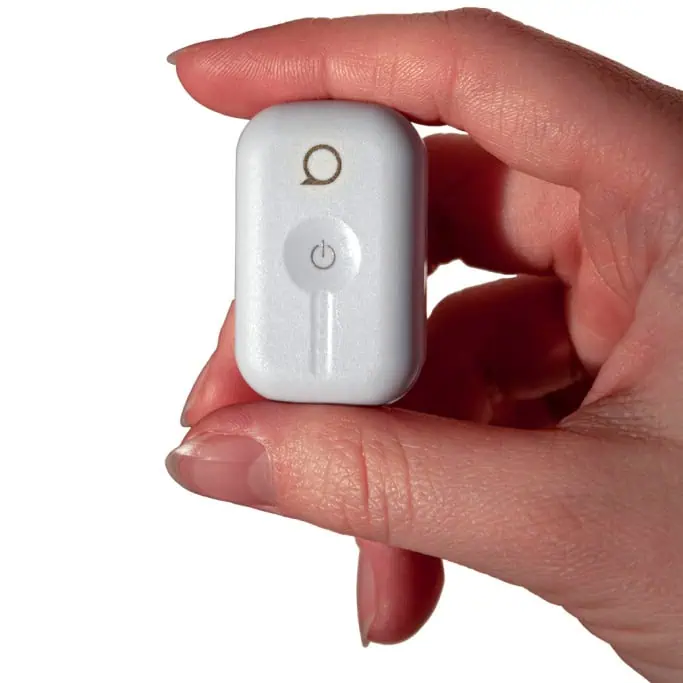
- Dimensions: 38.9 × 24.3 × 10.2 mm
- Weight: 8 grams
- Housing: IP67 or better
- User interface: Button + LEDs
- Connectivity: Micro-USB (charging & communication)
Memory
- Flash memory: 8 MB, used for recording to the sensor’s internal storage
Recording duration on the internal storage depends on the sampling rate and the transmission rate:
- 128 min at 50 Hz sampling rate and 5 Hz transmission rate
- 64 min at 100 Hz sampling rate and 10 Hz transmission rate
- 32 min at 200 Hz sampling rate and 20 Hz transmission rate
- 16 min at 400 Hz sampling rate and 40 Hz transmission rate
- 8 min at 800 Hz sampling rate and 80 Hz transmission rate
Changing the transmission rate increases or decreases the duration accordingly. Recording continues even if the BLE connection is lost, and stops when the storage is full or recording is stopped.
Wireless Communication
- Protocol: BLE 5.2
- Data rate: up to 2 Mbps
- Features: Data Length Extension (DLE), Nordic UART Service (NUS)
Environmental Specifications
- Indoor / Outdoor use: supported
- Altitude: < 2,000 m
- Operating temperature: 5°C to 40°C
- Storage temperature: 10°C to 35°C
- Relative humidity: up to 85%
- Pollution degree: 2
Connectivity & Interfaces
- Charging & wired communication: Micro-USB, 5V, 500mA
- Wireless: BLE 5.2
- Interfaces:
- Core Interface (direct sensor memory access)
- Serial Interface via QSense BLE Dongle
Compliance & Certification
- CE certified
Supported Platforms
- Windows 10 / 11
- Android 8+
- iOS 16+ (native API in beta)
- macOS (via BLE / serial interface)
- Linux (via serial interface)
Wireless BLE dongle is also compatible with macOS and Linux.
Integration & Customization
The QSense IMU Motion Sensor is available in:
- Standard housed version (IP67)
- OEM version (PCB + battery, without housing) for direct integration into customer products
Customization options include:
- regulatory support (CE / FCC / MDR)
- production according to ISO 13485 processes
- firmware variants
- mechanical integration support
- custom enclosures
- algorithm adaptation
Need More Details?
For interface documentation, integration support or custom configurations, contact QSense directly.
Contact QSense MotionQSense is developed and supported by 2M Engineering.



 English
 Spanish
 German
 French
 Dutch