
Motion Intelligence for Recovery, Function and Clinical Decision Support
In rehabilitation and healthcare, understanding how a patient moves is essential for effective treatment and recovery. QSense provides motion intelligence that enables clinicians and care teams to objectively measure, analyze and monitor human movement – in the clinic, at home and across the full rehabilitation pathway.
From early assessment to return-to-function decisions, QSense helps translate movement data into meaningful clinical insight.

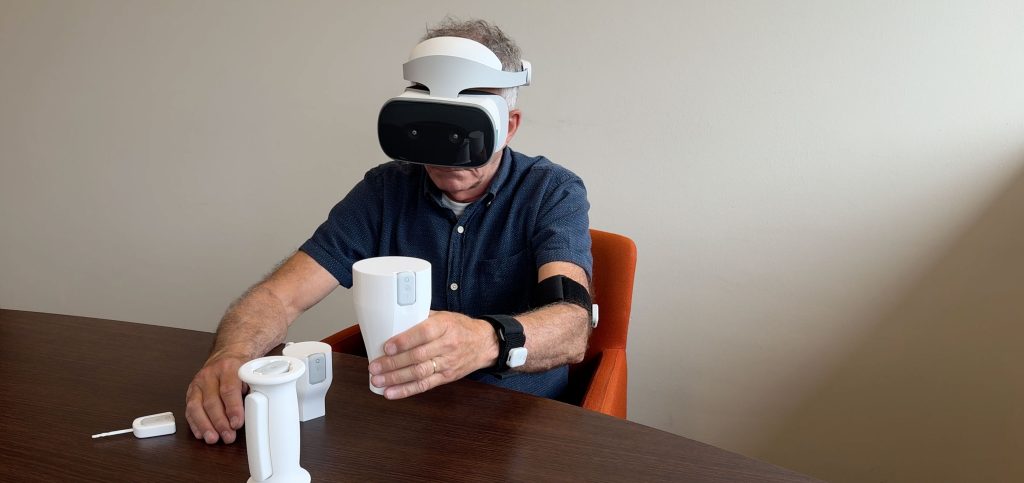
Why Motion Intelligence Matters in Rehabilitation
Many rehabilitation decisions are still based on visual observation, patient feedback and periodic assessments. While valuable, these approaches can miss subtle changes in movement quality, compensation patterns and asymmetries.
QSense brings objective, high-resolution motion data into clinical workflows – enabling:
- better insight into movement quality and control
- early detection of compensations and maladaptive patterns
- more precise monitoring of progress over time
- data-informed adjustment of therapy programs
When recovery and long-term function are at stake, observation alone is not enough.

What QSense Enables in Rehabilitation & Health
Movement Quality Assessment
Gain detailed insight into joint kinematics, coordination and control. Identify compensations, asymmetries and altered movement strategies that impact recovery.
Progress Monitoring & Outcome Tracking
Objectively track changes in movement over time. Support clinical evaluation with data rather than subjective impression alone.
Return-to-Function & Readiness Decisions
Support decisions about progression, discharge and return to activity with objective movement metrics rather than timelines alone.
Remote Monitoring & Home-Based Rehabilitation
Enable consistent monitoring beyond the clinic. Support blended care, tele-rehabilitation and long-term follow-up with reliable motion data.
Typical Use Cases
QSense is used in rehabilitation and healthcare for:
- gait analysis and functional mobility assessment
- stroke rehabilitation and neurological recovery
- orthopedic rehabilitation (ACL, hip, knee, ankle, shoulder)
- post-operative recovery monitoring
- balance and fall risk assessment
- return-to-function evaluation
Whether in the clinic, rehabilitation center or home environment, QSense delivers motion insight in real-world conditions.
Gait & Functional Mobility Assessment
QSense enables objective analysis of gait, posture and functional mobility in both clinical and real-world settings. By capturing detailed kinematic data, clinicians gain insight into movement quality, asymmetries and compensatory strategies that are often difficult to detect through observation alone. This supports more precise assessment, targeted intervention and better monitoring of recovery over time.
Neurological Rehabilitation & Stroke Recovery
In neurological rehabilitation, subtle changes in movement quality and control are critical indicators of recovery. QSense provides objective motion data to track progress, identify compensations and support individualized therapy planning for stroke patients and other neurological conditions. This enables clinicians to go beyond subjective observation and base progression decisions on measurable change.
Orthopedic Rehabilitation & Return-to-Function
QSense supports objective assessment throughout orthopedic rehabilitation, including post-operative recovery after ACL, hip, knee, ankle and shoulder procedures. By tracking movement patterns, load distribution and compensations, clinicians can better evaluate readiness to progress and support safer return-to-function decisions.
Designed for Clinical Workflows
Healthcare environments demand technology that is reliable, unobtrusive and easy to integrate.
QSense is designed for:
- fast setup in clinical settings
- real-time and longitudinal measurement
- multi-sensor configurations across the body
- integration with rehabilitation software and data systems
- use in both supervised and unsupervised settings
From assessment to discharge, QSense fits into real rehabilitation workflows.

From Observation to Objective Insight
QSense helps clinicians move beyond subjective observation toward data-informed decision making. By providing consistent, high-quality motion data, we support:
- more precise diagnosis
- better therapy personalization
- improved outcome tracking
- increased confidence in clinical decisions
We don’t replace clinical expertise – we strengthen it with objective insight.
A Partner in Clinical Innovation
QSense works with clinicians, researchers, healthcare organizations and technology partners to develop motion-driven rehabilitation solutions that work in practice.
We support:
- clinical pilots and validation studies
- system integration and customization
- algorithm development
- product development for digital health solutions
We are not just a technology provider – we are a partner in building better rehabilitation solutions.
Let’s Talk About Your Clinical Application
Whether you are improving clinical assessment, developing digital rehabilitation solutions or optimizing care pathways, QSense provides the motion intelligence foundation to support recovery and long-term function.
Talk to Our Team


 English
 Spanish
 German
 French
 Dutch