
Biomechanics Research & Methods with QSense IMU Motion Sensors
QSense Motion is specialised in IMU Sensor solutions for Biomechanics Research. Our motion sensors are designed to provide the precise data necessary for detailed movement analysis.
With our cutting-edge technology, researchers can gain deep insights into human movement, ergonomics, and sports science, leading to groundbreaking discoveries and improved applications in various fields.
Contents

Why QSense IMU Motion Sensor for Biomechanics Research?
Our sensors are equipped with advanced technology to measure complex movements accurately and with ease. The protocols behind those measurements are described under gait analysis methods. This makes them ideal for research in biomechanics, ergonomics, and more. The precise data collected by our sensors enables researchers to analyze movements in great detail, providing a solid foundation for understanding and improving human motion in various contexts.
Features of QSense Motion Sensors
High Precision
One of the key features of QSense Motion’s biomechanics research tools is their high precision. Our sensors deliver accurate data that is crucial for in-depth analysis of movements. This precision ensures that researchers can trust the data they collect, leading to more reliable and meaningful results in their studies.
User-Friendly
Our sensors are designed to be user-friendly, making them easy to set up and integrate with existing systems. This ease of use allows researchers to focus on their work without being bogged down by complex technology. The intuitive interface and straightforward setup process ensure that our sensors can be quickly incorporated into any research project.
Durable
QSense Motion sensors are built to last under various research conditions. Whether used in controlled laboratory settings or in the field, our sensors are designed to withstand rigorous use and provide consistent performance. This durability makes them a dependable choice for long-term research projects.
Flexible & Versatile Output Formats for Advanced Research
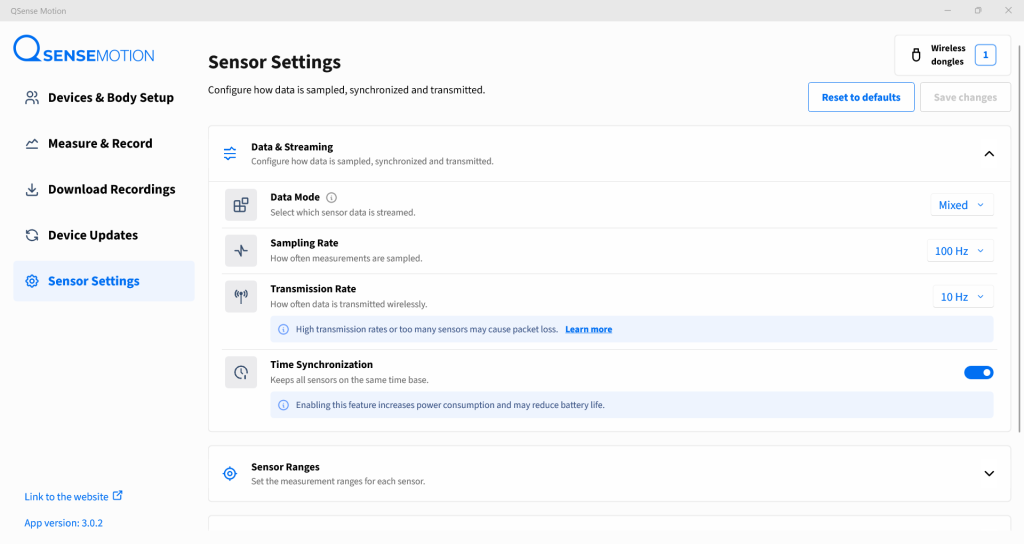
QSense provides a comprehensive range of output formats tailored for biomechanics research. Whether you need 9DOF or 6DOF quaternions, raw sensor data, or mixed-mode outputs, QSense delivers the flexibility required for diverse research applications. Designed for seamless integration, it stands out as one of the most versatile solutions for modern biomechanics studies.
Applications of QSense IMU Motion Sensors
Human Movement Studies
In human movement studies, QSense Motion sensors are used to analyze gait, posture, and other biomechanical phenomena. By providing detailed data on how people move, our sensors help researchers understand the mechanics of movement and identify ways to improve performance and prevent injuries. This information is invaluable for developing new therapies and interventions that enhance human mobility.
Ergonomics
Ergonomics is another area where QSense Motion sensors excel. By capturing precise movement data, our sensors help researchers design products that are more comfortable and effective for users. This can include everything from office furniture to wearable technology. By improving the ergonomics of products, companies can enhance user satisfaction and reduce the risk of injury.
Sports Science
In sports science, precise movement analysis is essential for enhancing athletic performance. QSense Motion sensors provide the detailed data needed to understand how athletes move and identify areas for improvement. This information can be used to develop training programs that enhance performance, reduce the risk of injury, and help athletes reach their full potential.
How IMU Sensors are used in biomechanics research
IMU (Inertial Measurement Unit) sensors play a crucial role in biomechanics research, enabling precise motion tracking and movement analysis in real-world environments. By measuring acceleration, angular velocity, and sometimes magnetic field data, IMUs provide researchers with detailed insights into joint kinematics, gait patterns, posture, and overall human movement dynamics. Unlike traditional motion capture systems that rely on external cameras, IMU-based motion tracking allows for unrestricted, portable, and real-time monitoring, making it ideal for applications such as sports performance analysis, rehabilitation studies, and ergonomics research. With advancements in sensor accuracy and data fusion algorithms, IMUs are revolutionizing biomechanics by providing high-fidelity motion data outside of controlled lab settings, enabling more natural movement assessments.
Conclusion
QSense Motion offers the biomechanical research tools you need for accurate and reliable data. Our sensors are designed to provide high precision, user-friendly integration, and durability, making them ideal for a wide range of research applications. Whether you are studying human movement, ergonomics, or sports science, our technology provides the insights you need to make meaningful advancements in your field. Contact us today to learn more about how our solutions can support your research and help you achieve your goals.
Contact Us
To discover how QSense Motion’s biomechanical research tools can enhance your projects, get in touch with our team. We are dedicated to providing advanced motion tracking solutions that meet the needs of researchers across various disciplines. Contact us today to learn more about our products and how we can help you achieve precise and reliable data for your biomechanical studies.
By offering high precision, user-friendly integration, and durable performance, QSense Motion’s sensors are designed to meet the rigorous demands of biomechanical research. Explore the applications and discover how our technology can transform your approach to studying human movement, ergonomics, and sports science. Contact us today to get started with the most advanced biomechanical research tools available.
More information?
For more information about our products and services, or if you have specific questions, feel free to reach out to us. The QSense team is here to assist you with any inquiries you might have. QSense is developed by 2M Engineering.
Contact QSense MotionFrequently Asked Questions
What is QSense, and how does it help in biomechanics research?
QSense is a high-precision IMU-based motion tracking system designed for biomechanics research. It provides real-time movement data, allowing researchers to analyze joint kinematics, gait, posture, and human motion dynamics in both lab and real-world settings.
What types of motion data can QSense capture?
QSense captures linear acceleration, angular velocity, and orientation using 9DOF and 6DOF quaternions, as well as raw sensor data. This makes it ideal for analyzing complex human movements in sports science, rehabilitation, and ergonomics.
How accurate is QSense compared to optical motion capture systems?
QSense offers high-fidelity motion tracking, often achieving comparable accuracy to optical systems for many applications. Unlike camera-based systems, QSense provides portable, marker-free tracking without line-of-sight restrictions, making it ideal for out-of-lab studies and real-world biomechanics research.
Can QSense be used for gait analysis?
Yes! QSense is commonly used for gait analysis in clinical and sports settings. It can measure stride length, step cadence, joint angles, and asymmetry, making it valuable for studying rehabilitation progress, injury prevention, and athletic performance.
What output formats does QSense support?
QSense offers a wide range of output formats, including:
• 9DOF & 6DOF quaternions
• Raw sensor data (acceleration, gyroscope, magnetometer)
• Mixed modes for customized motion analysis
These formats ensure compatibility with biomechanics software and custom data processing pipelines.
Does QSense integrate with biomechanics software?
Yes! QSense can be integrated with popular biomechanics software such as MATLAB, Python, LabVIEW, and other data analysis platforms via its API and SDK. This makes it easy to process and visualize motion data for research.
Is QSense wireless or wired?
QSense uses wireless motion tracking, allowing for untethered movement analysis. This makes it ideal for natural, unrestricted motion studies in sports science, rehabilitation, and ergonomics.
How does QSense handle motion drift?
QSense employs advanced sensor fusion algorithms to minimize drift and data errors. By combining accelerometer, gyroscope, and magnetometer data, it ensures stable and accurate motion tracking over extended periods.
Can QSense be used outdoors?
Yes! Unlike optical motion capture systems that require controlled environments, QSense’s IMU-based system works indoors and outdoors, making it perfect for field studies in sports, rehabilitation, and occupational research.
How many IMU sensors can be used simultaneously?
QSense supports multi-sensor configurations, allowing researchers to track multiple body segments at once. This enables full-body motion analysis for applications like biomechanical modeling, postural assessment, and sports performance tracking.
Is QSense suitable for real-time motion tracking?
Yes! QSense IMU Sensors provides low-latency real-time motion tracking, making it ideal for applications like live performance feedback, virtual reality (VR) biomechanics, and real-time gait analysis.
What is the battery life of QSense sensors?
QSense sensors are designed for long-duration research studies, offering several hours of continuous use on a single charge. Exact battery life depends on sampling rate and usage conditions.
Is QSense suitable for rehabilitation and clinical research?
Absolutely! QSense is widely used in rehabilitation studies to monitor patient recovery, postural control, and neuromuscular disorders. It provides objective data to assess progress and refine treatment plans.
Where can I buy QSense motion tracking sensors?
You can purchase QSense directly from our website or through authorized distributors. Contact us for pricing, bulk orders, or academic research discounts.
Can I request a demo or trial for research purposes?
Yes! We offer demos and research trial programs for universities, research labs, and biomechanics professionals. Contact our team to discuss your project needs and see how QSense can support your research.



 English
 Spanish
 German
 French
 Dutch