
How Inertial Measurement Units (IMUs) Capture Human and Object Motion
Introduction
IMU-based motion tracking is the foundation of modern wearable sensing, robotics, virtual reality, and biomechanical analysis. From tracking body movement in sports and rehabilitation to stabilizing drones and robots, Inertial Measurement Units (IMUs) enable precise motion measurement without relying on cameras or external infrastructure.
This page explains how IMU motion tracking works, what IMUs measure, how sensor data is combined into meaningful motion information, and how IMU-based systems compare to optical motion capture.
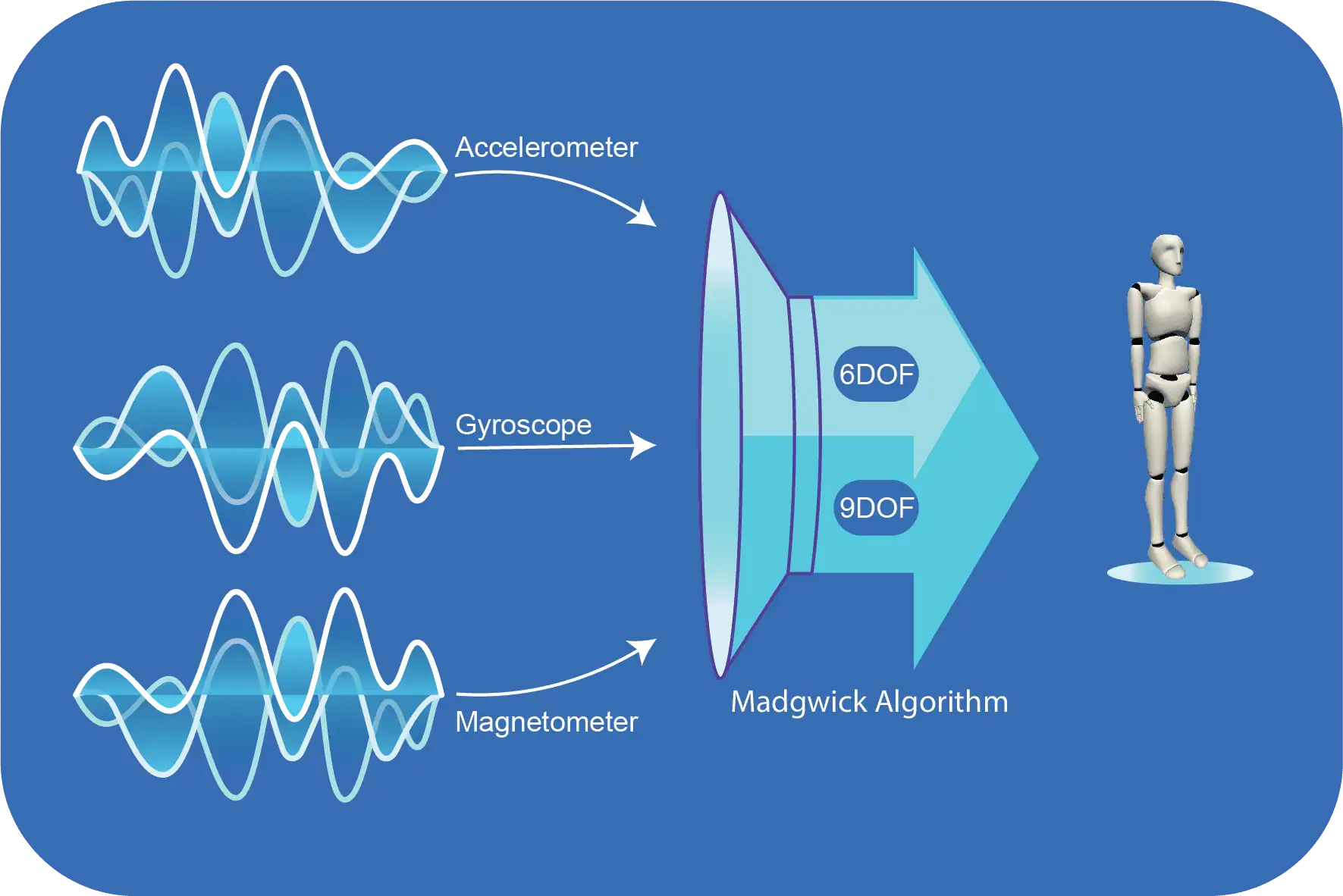
What is an IMU Motion Sensor?
An Inertial Measurement Unit (IMU) is a device that measures and reports specific force, angular rate, and sometimes An Inertial Measurement Unit (IMU) is a compact electronic device that measures motion and orientation in three-dimensional space. It does this by combining multiple sensors into a single unit.
Core IMU Components
- AccelerometerMeasures linear acceleration along the X, Y, and Z axes. This includes both movement-induced acceleration and gravity.
- GyroscopeMeasures angular velocity (rotation rate) around the X, Y, and Z axes.
- Magnetometer (optional)Measures the Earth’s magnetic field and provides a directional reference (similar to a digital compass).
Together, these sensors allow an IMU to track how an object or body segment moves and rotates over time.
How IMU Motion Tracking Works
IMU motion tracking relies on continuous measurement and mathematical interpretation of sensor signals.
Step-by-Step Overview
- Sensor Measurement
- Accelerometers detect changes in linear motion and orientation relative to gravity
- Gyroscopes measure rotational motion
- Magnetometers (if used) provide heading reference
- Sensor FusionIndividual sensors have limitations when used alone. Sensor fusion algorithms combine their outputs to reduce noise and drift.Common approaches include:
- Madgwick filter (low latency, efficient)
- Complementary filtering
- Kalman-based methods
- Orientation & Motion EstimationThe fused data is used to calculate:
- Orientation (often expressed as quaternions)
- Angular velocity
- Linear acceleration (gravity-compensated)
- Data OutputThe resulting motion data is streamed or logged in formats suitable for:
- Real-time feedback
- Offline analysis
- Integration into external software or pipelines
Orientation, Frames & Quaternions (Briefly)
To avoid issues like gimbal lock, IMU systems typically represent orientation using quaternions instead of Euler angles.
- Body frame: orientation relative to the sensor itself
- Global frame: orientation relative to a fixed reference (e.g. gravity or magnetic north)
Quaternions provide:
- Stable 3D orientation
- Smooth interpolation
- Efficient real-time processing
(For a deeper explanation, see Orientation, Frames & Quaternions.)
IMU-Based Motion Tracking vs Optical Motion Capture
Optical Motion Capture
- Uses cameras and reflective markers
- Extremely high positional accuracy
- Requires controlled environments and line-of-sight
- Expensive and infrastructure-heavy
IMU-Based Motion Tracking
- Wearable and portable
- Works indoors, outdoors, and in the field
- No cameras or markers required
- Scales easily to multi-sensor setups
- Ideal for real-world, long-duration measurements
While optical systems remain valuable for laboratory-grade positional tracking, IMUs excel in mobility, accessibility, and real-world applicability.
What IMU Motion Tracking Is Used For
IMU-based systems are widely used across industries:
Sports & Performance
- Technique analysis
- Load monitoring
- Real-time feedback during training
Rehabilitation & Healthcare
- Gait analysis
- Range-of-motion tracking
- Long-term monitoring outside the clinic
Virtual Reality & XR
- Full-body tracking
- Low-latency orientation data
- Wearable interaction without cameras
Robotics & Automation
- Stabilization and navigation
- Joint and limb motion sensing
Research & Biomechanics
- Human movement studies
- Field-based experiments
- Multi-sensor synchronization
Benefits of IMU Motion Tracking
- Portability – usable anywhere, not limited to studios
- Scalability – easy to add more sensors
- Real-time feedback – low-latency streaming possible
- Continuous tracking – no occlusion issues
- Cost-effective – lower system complexity than optical setups
Limitations to Be Aware Of
IMUs are powerful, but not without trade-offs:
- Drift: small integration errors accumulate over time
- No absolute position: IMUs track relative motion, not global position
- Magnetic sensitivity: magnetometers can be disturbed by metal or electronics
- Calibration required: accuracy depends on proper calibration and setup
Modern systems mitigate many of these limitations through:
- Time synchronization
- Intelligent fusion algorithms
- Application-specific configuration
Why IMUs Are Central to Modern Motion Tracking
IMU-based motion tracking has shifted motion analysis from controlled labs to the real world. As sensors become smaller, more accurate, and more energy-efficient, IMUs enable new applications that were previously impractical or too expensive.
They are not simply a replacement for optical systems — they are a different class of motion technology, optimized for mobility, scale, and integration.
Frequently Asked Questions (FAQs)
How Accurate are IMU Motion Sensors?
IMU accuracy depends on the quality of the sensors, sensor fusion algorithms, and external calibration. High-end IMUs used in aerospace and robotics can achieve extremely precise motion tracking, while consumer-grade IMUs may suffer from drift over time.
What is IMU Drift, and How Can It Be Corrected?
IMU drift occurs due to small errors accumulating over time in the gyroscope’s measurements. This issue can be minimized using sensor fusion techniques like Kalman filtering, which combines IMU data with external sources like GPS or optical tracking.
How Do IMUs Differ from GPS Sensors?
IMU sensors track motion in real-time without requiring external signals, making them ideal for indoor applications.
GPS sensors provide absolute position data based on satellite signals but are less effective indoors or in obstructed areas.
Combining IMUs with GPS results in highly accurate navigation systems, used in autonomous vehicles and aerospace applications.
Can IMUs Work Underwater?
Yes, IMUs can function underwater, but magnetometers may not work accurately due to the lack of a stable magnetic reference. In such cases, depth sensors and water-resistant IMUs with advanced filtering algorithms are used for underwater navigation.
What are Some Emerging Trends in IMU Technology?
Miniaturization: Advances in MEMS (Micro-Electro-Mechanical Systems) technology have led to smaller, more efficient IMUs.
AI & Machine Learning: Improved sensor fusion using AI enhances real-time motion tracking and prediction.
Higher Precision & Lower Cost: As IMU technology advances, high-accuracy sensors are becoming more affordable for commercial applications.


 English
 Spanish
 German
 French
 Dutch